Who Bears the Sword
We are not going to keep AI out of war. The harder question, the church should be asking, is whether we will still carry the moral weight of the sword, or hand it to a machine & call our hands clean.


In the first thirty-eight days of its war on Iran, an operation the Pentagon called Epic Fury, the United States struck a reported thirteen thousand targets, coordinated through Palantir’s Maven targeting system. None of that pace is humanly possible without artificial intelligence, and nobody in a position to know is pretending otherwise. The military’s chief digital and AI officer told a defense outlet that troops had shown an “insatiable appetite” for the technology, and that his “biggest fear is, can we keep up?”
AI is in warfare to stay. There will not be another major war fought without it. Our enemies will use it and we will use it, and a Christian who meets that fact with “then we should refuse” is not being righteous, he is being late. The cat is out of the bag, the box is open, and the only useful question is whether we will use this power wisely, ethically, and justly, or let its speed do our thinking and call the result progress.
The same machine, only pointed at us
The Beast You’re Watching For described an AI the Israeli military named, without apparent irony, “the Gospel,” and a companion system called “Where’s Daddy?” that waited for a man to come home so it could kill him there with his family. Its argument was that Christians scanning a chatbot for the mark of the beast were looking in the wrong direction. The real horror was already running, over there, with a name.
The harder truth is that it was never only over there. The same season, in Iran, the United States ran a larger version of the same thing, and the company at the center of both is the same company. Palantir built the data tooling behind Israel’s targeting, and Palantir builds Maven, the “smart system” that prioritized those thirteen thousand American targets. The thread that runs from Gaza to Iran is not an analogy. It is a vendor, and a chief executive who is glad to tell you what it is for.
A school the system did not see
In southern Iran, a strike on a girls’ school next to a Revolutionary Guard compound killed as many as a hundred seventy people, most of them schoolgirls. One analyst tracking the campaign put the failure on the record in the plainest possible terms: the system “did not identify the school as a school.” Whatever else that sentence is, it names the exact thing every serious tradition of moral reflection on war exists to prevent. Hold the number a moment, because the argument that follows has to answer to it. So does mine.
We already built the framework for this
Here is something the church should remember and mostly has not. The West’s entire framework for restraining war is a Christian inheritance. Just War theory is not a secular invention we reluctantly adopted. Augustine worked it out in the fourth and fifth centuries, arguing that the sword belongs to the governing authority for the protection of the innocent and the restraint of evil, and that the very same war could be an act of love for neighbor or a great wickedness depending on why and how it was fought. Thomas Aquinas systematized it: legitimate authority, just cause, right intention, and inside the fighting itself two unbreakable rules, discrimination and proportionality. You may not aim at the innocent. You may not do harm out of proportion to the good you pursue.
Notice what that tradition is not. It is not pacifism. It has always assumed that in a fallen world war will come, and its whole purpose is to govern how. That is exactly the posture this moment asks for. The question was never whether to fight, or even whether to fight with these tools. The question is whether the fighting stays inside the lines that make a war just. By those lines, the school strike is not a hard case. A strike that cannot tell a school full of girls from a military target has failed the oldest test we have.
Palmer Luckey is mostly right
And yet the most serious advocate for AI in war makes a largely persuasive argument, one worth stating at full strength before complicating it. Palmer Luckey, who founded the defense company Anduril, likes to point out that the real choice is not between smart weapons and no weapons. It is between smart weapons and dumb ones. “There’s no moral high ground,” he has said, “to making a land mine that can’t tell the difference between a school bus full of children and Russian armor.” He is right. A weapon that can discriminate is morally preferable to one that cannot, and a Christian who actually cares about the people on the wrong end of a war should want better discrimination, not less of it. Luckey is also right that the technology is here, that refusing it does not make it vanish, and that it is better for the United States to lead than to cede the ground. I do not have a quarrel with any of that.
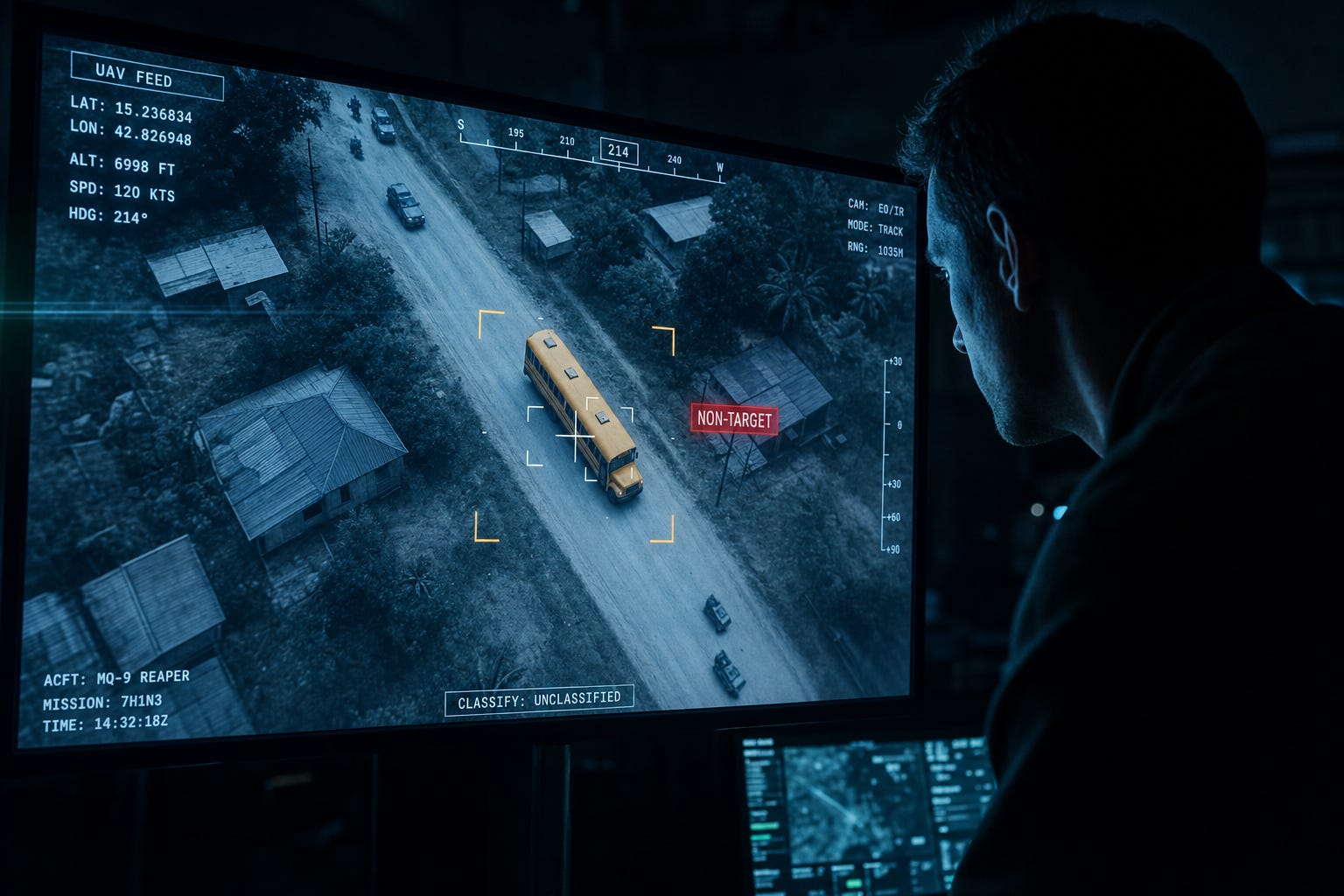
Three things complicate it, and every one of them rides on agreeing with him.
The first is that the world already settled his underlying point, and settled it harder than he lets on. The reason a landmine that cannot tell a tank from a school bus is monstrous is that it cannot discriminate, and the response of most of the world to precisely that problem was not to shrug. It was to ban it. The 1997 Mine Ban Treaty, signed by more than a hundred sixty nations, exists because indiscriminate autonomous weapons were judged intolerable. That history does not refute Luckey. It confirms his premise and then hands him a standard. If “smart” is the whole moral justification, then smart has to actually discriminate, in the field, every time. The promise is the price of admission.
The second is that “can discriminate” and “does discriminate” are not the same sentence. Every advance in the history of weapons has been a march toward the same two things, speed and precision, and for most of that history they traveled together. The sling reached farther than the arm, the arrow flew faster and truer than the hurled spear, the chariot outran the man on foot, the rifle outshot the musket, the guided bomb fell closer to the mark than the one simply dropped. Each leap made killing quicker and, more often than not, more exact. What is new is a speed that has finally outrun precision. Thirteen thousand targets in thirty-eight days is a tempo at which the discrimination Luckey promises stops being something a human can actually perform. He is describing a capability in principle; that strike is a performance in fact, at machine speed, and a system that could in theory tell a school from a barracks but did not is not a triumph of precision. It is the marketing failing its own test. We have built more intelligence than any people in history and bought no wisdom with it, which is the oldest gap there is, only newly lethal. Making war faster was never the thing we needed, and we cannot seem to slow these things down. The Christian move here is not to reject precision. It is to hold the system to the standard its own defenders invoke.
The third is the one that matters most, and it is not about accuracy at all. The deepest danger in any of this is not a machine too dumb to tell a bus from a tank. It is a person too eager to stop carrying the weight. Watch a chatbot slide into the kill chain, and the line that lands is the one going around: we feared the machine seizing control, and instead we begged it to take it. That is the whole thing. “Everyone is using it” and “the machine decided” are not arguments. They are laundromats, places to send the moral weight so it comes back clean and nobody’s name is on it. Thirteen thousand targets in thirty-eight days, an insatiable appetite, can we keep up. That is not a human in the loop. That is a human reduced to a stamp on a process moving too fast to judge. Even Luckey, I suspect, would call that the line. It is the discipline his own vision needs to stay honest.
What they did to the one who said no
There is a parable in the recent record, if you are willing to read it as one. Earlier this year, when the Department of War, as the Pentagon is now styled, demanded that one AI company hand over its model for “all lawful purposes,” that company refused. Its reasons were exactly the two at issue here. It said current models are not reliable enough to be trusted with fully autonomous lethal force, and it said mass domestic surveillance of citizens violates fundamental rights. For drawing those two lines, Anthropic was branded a national-security supply-chain risk, ordered out of federal use, and called, by one of the most powerful men in technology, an enemy of Western civilization. A federal judge later found that the government had punished the company for its “hostile manner through the press,” and named the move for what it was, First Amendment retaliation. Hours before the Iran war began, a rival lab signed the deal Anthropic would not. And the banned model, by multiple accounts, was used to help plan the strikes anyway.
I am not asking you to canonize a corporation. I am asking you to notice what happened to restraint. You can doubt whether it is a private company’s place to tell the government no, whether the call on lethal force belongs to a CEO in Silicon Valley rather than to elected authority, and still take with full seriousness the two concerns behind the refusal. Whether Anthropic had the standing to draw the line is a fair argument; whether the line is real is not. A model not yet reliable enough to be trusted with autonomous lethal force, and the mass surveillance of citizens, are exactly the things a conscience should refuse to wave through, whoever raises them. The one firm that tried to hold a line got treated as the threat, and the machinery rolled forward without it. That is the thing to watch, because it is not an argument against American strength. It is a warning about what a race does to the very restraint that makes strength worth trusting. Pro-American and pro-restraint are not opposites. The danger of this moment is being told that they are.
Karp and the belief problem
The man who runs Palantir would tell you the problem is the opposite of restraint. Alex Karp has written a whole book arguing that the West has gone soft, that it has lost its nerve and its sense of common purpose, that it suffers from what he calls a “soft belief” and needs to recover the will to build hard power and use it. He is not coy about the using. Palantir, he has said, exists “to scare enemies and on occasion kill them,” and he has quoted the political scientist Samuel Huntington with approval: the West rose, Huntington wrote, “by its superiority in applying organized violence,” a fact “Westerners often forget” and “non-Westerners never do.”
Karp deserves more than his critics grant him, because his diagnosis is half right, and it is the half closest to my own work. The secular West really has lost its belief. It has hollowed out the metaphysical floor it used to stand on and is surprised to find itself wobbling. Karp sees the hole. What he gets wrong is the filling. The belief he prescribes is belief in the West itself, in the civilization, in its will to apply force, and a belief in the West can never sit in judgment over the West. It can only cheer it on. Conviction with no master above the nation is not a recovery of belief. It is the oldest substitution there is, the flag set in the place where God used to be. And it produces precisely what we are looking at: “on occasion kill them,” said with pride, thirteen thousand targets in thirty-eight days, a school the system did not see.
Karp himself traces it to Calvinism. What is special about America, he argued on the All-In Podcast, is that “we are the most Calvinist culture in the world,” and Calvinism “celebrates success” where the anti-Calvinist cultures of Europe assume that “behind every great success is a great crime.” He is not wrong about the root. The Reformed conscience really is part of what built American confidence and drive. But that conscience handed this country more than a license to celebrate winning. The same Calvinism that taught America to honor achievement also taught it that achievement is not the highest thing, that the winner is not thereby good, that the strong will answer to Someone stronger. Strip the second lesson and keep the first and you have not made America more itself. You have kept its appetite and discarded its conscience, and a culture that does that does not grow stronger. It forgets why its strength was ever worth trusting.
Here is the irony the whole project rests on and never quite faces. Karp wants the hard power of Christendom without the soft belief that civilized it. The restraints he treats as weakness, the bounded sword, the immunity of the non-combatant, the conviction that the enemy’s child is made in the image of God, did not come from the West’s superiority in applying violence. They came from its creed. They are the gift of the very belief he calls soft. You cannot keep the sword inside the lines once you have decided the lines were only ever cowardice.
The sword we were handed
So what does Scripture actually give us to hold? It gives us a destination first, and it is worth starting there so the rest is framed by hope and not by dread. The prophets promised a day when God “shall judge between the nations” and the peoples “shall beat their swords into plowshares, and their spears into pruning hooks,” when “nation shall not lift up sword against nation, neither shall they learn war anymore” (Isaiah 2:4). That is where all of this is going. The end of war is not a treaty we will finally negotiate. It is a King who will arrive.
But we are not there yet, and pretending we are is its own kind of lie. We live in the long meantime, in a world still fallen, where evil is real and someone has to restrain it, and so the sword remains. Paul says the governing authority “does not bear the sword in vain,” that the ruler is “God’s minister, an avenger to execute wrath on him who practices evil” (Romans 13:4). That is a real warrant for real force. But read the whole sentence, because it is fenced on every side. The sword is for the evildoer, not the schoolgirl. The ruler is “a terror” to “evil,” not to “good works” (Romans 13:3). The same Scripture that hands the magistrate a sword spends enormous care separating the murderer from the man who killed by accident, building entire cities of refuge around the difference between the one who “hates his neighbor” and “lies in wait” and the one who “kills his neighbor unintentionally” (Deuteronomy 19:4, 11). The God who permits the sword hates “hands that shed innocent blood” (Proverbs 6:16-17), and the reason He gives for taking blood seriously at all is that man was made “in the image of God” (Genesis 9:6). Discrimination is not a modern legal nicety bolted onto war. It is written into the floor of biblical justice. The non-combatant is not collateral. The non-combatant is the whole reason the sword has a sheath.
And the standard does not stop at discrimination. “He has shown you, O man, what is good,” the prophet says; what is required is “to do justly, to love mercy, and to walk humbly with your God” (Micah 6:8). That is the entire job description for anyone handed power over another life. Set thirteen thousand targets in thirty-eight days beside it. We are doing none of the three, and where justice and mercy and humility are all absent, the outcome is not a mystery. It bends toward evil, because that is the direction we bend. The same Scripture that fences the sword is honest about the hand that grips it: after Eden, God “saw that the wickedness of man was great in the earth, and that every intent of the thoughts of his heart was only evil continually” (Genesis 6:5). We are the creatures who reached first for the tree of the knowledge of good and evil, and the tools we have built ever since have tended the same way, growing in their capacity for harm faster than in their capacity for good. A weapon that kills at the speed of thought, put in a hand like that, is not a neutral instrument waiting to be aimed well. It is an old appetite given a new engine, which is exactly why the restraint matters, and exactly why we were never going to be able to supply it on our own.
Put the destination and the meantime together and you have the posture the moment requires. We are people who carry a sword we long to lay down, in a world that still requires it, toward a day when the One who can will take it from every hand at once. That posture has room for AI in war. It has no room for getting comfortable. It will not let us refuse the tools our enemies will use, and it will not let us hand off the judgment that makes their use just. We will fight with these systems. The only question is whether we stay the kind of people who can still tell a school from a target, who keep the moral weight on a human shoulder where God set it, or whether we let the speed decide and tell ourselves the machine did it.
Until the swords are plowshares
I want the United States to lead in this technology. Nothing here is a brief for weakness, or for handing the future to people who mean us harm. It is a brief for remembering whose hand the sword was put in, and why, and for how long.
The machine is not the beast. The temptation is the old one, to set down a weight God meant us to carry and call the lighter load righteousness. So carry it. Name the lines you will not cross, the way Anthropic did, even when the line costs you. Honor the soldier and the real defense of the innocent. And refuse to worship either the machine that makes the killing fast or the nation that makes it feel holy. The God who handed the magistrate a sword is going to ask how it was used, and “the system did not identify the school as a school” will not be an answer that holds.
A day is coming when none of this is necessary. The swords become plowshares. The spears become pruning hooks. No one studies war anymore, because the King who ends it has come and there is nothing left to fight. We are not there yet. So we carry the sword soberly, grieving that we still need it, longing for the morning we will not, and we are not allowed to put down its weight before then. But we get to know it is the next-to-last word. The last word is a field, and a plow, and a long peace, and the One who was always going to win.
Sources
Operation Epic Fury target figures and the “insatiable appetite” / “can we keep up” quotes from the Pentagon’s chief digital and AI officer: Breaking Defense, “’Insatiable appetite’ for AI: Maven usage surged for strikes on Iran, Pentagon AI chief says”, and Democracy Now!, “Speeding Up the ‘Kill Chain’: Pentagon Bombs Thousands of Targets in Iran Using Palantir AI”.
US military AI targeting and oversight concerns: NBC News, “US military is using AI to help plan Iran air attacks”; Al Jazeera, “US military confirms use of ‘advanced AI tools’ in war against Iran”.
The school strike and the “did not identify the school as a school” testimony: Democracy Now!, “Speeding Up the ‘Kill Chain’”.
The Israel parallel (”the Gospel,” “Where’s Daddy?,” Lavender): +972 Magazine, “’Lavender’: The AI machine directing Israel’s bombing spree in Gaza”.
The Anthropic / Department of War dispute, the refusal, the ban, and Judge Lin’s “First Amendment retaliation” ruling: Wikipedia, “Anthropic–United States Department of Defense dispute”; Congress.gov CRS, “Pentagon-Anthropic Dispute over Autonomous Weapon Systems”; The Washington Post, “Pentagon leverages AI in Iran strikes amid feud with Anthropic”.
Palmer Luckey on smart vs. dumb weapons and the landmine analogy: CBS News / 60 Minutes, “Why Palmer Luckey thinks AI-powered autonomous weapons are the future of warfare”.
The 1997 Mine Ban Treaty (Ottawa Convention): Ottawa Treaty (overview).
Alex Karp’s thesis and quotes: The Technological Republic: Hard Power, Soft Belief, and the Future of the West; for the “scare enemies and on occasion kill them” line, Gizmodo and Techdirt; the Huntington passage is from Karp’s February 2025 Palantir shareholder letter, reported by The Stack, quoting Samuel P. Huntington, The Clash of Civilizations and the Remaking of World Order (1996); for the Calvinism remarks, All-In Podcast, “Palantir CEO Alex Karp: Why the West is Destroying Itself” (Sept 9, 2025), ~29:50.
Companion essays: The Beast You’re Watching For and Who Holds the Switch.
Just War primary texts: Augustine, City of God, Book XIX and Against Faustus the Manichaean, Book XXII; Thomas Aquinas, Summa Theologica, II-II, Q. 40, “Of War”.
The “we begged it to” framing echoes a widely shared post by a self-described network engineer on X: @Hamzaonchain (”We feared Skynet taking control. Instead, we begged it to.”).
Scripture quotations are taken from the New King James Version (NKJV).
This article was developed using AI writing tools I built to work with my voice, research, and editorial framework. The ideas, arguments, and positions are mine. The pipeline that helps me draft, evaluate, and refine them is something I created as part of my work at Nomion AI. I believe in building with AI and being honest about it. If you want to know more about that process, ask me.
So good Miles! Come quickly LORD JESUS!