Why It's Critical
The question Steven Bartlett asked John Lennox, and the answer the church cannot leave on the table.

On the Diary of a CEO last week, Steven Bartlett put a question to John Lennox four different ways, and four times the answer slid past it.
Lennox, the Oxford mathematician and Christian apologist, had drawn the line most of us would draw. A machine can produce the right output without any understanding behind it. Point an AI at a coffee mug and it says “a mug.” Walk a person in and they say “a mug.” The words match; the awareness does not. “There’s a huge difference,” Lennox said, “in being a machine and responding to a program created by others and being aware of what you’re doing consciously. That’s a totally higher level of being.”
Bartlett kept pressing on the same nerve. “And why does that part, why is that critical?” A minute later: “I agree. But why does that matter in this context?” Again: “Why does the process matter if the output is identical?” And once more: “Why is it an important conversation to have, that it is conscious or not conscious, when the output is the same?”
Lennox gave good answers to a different question. He explained, rightly, why the machine is not conscious: it can combine things into forms that did not exist before, but it does not know it is doing so; the conscious life involves an appreciation of beauty and other persons and God that the machine comes nowhere near. All true. But Bartlett had not asked whether AI is conscious. He had asked why it matters. Why is it critical that we get this one right?
Watch what happened in the gap. Within about a minute of that unanswered question, Bartlett had drifted, on his own, into the next thing. There are “probably going to be some ethical questions around robotics,” he offered, the way many of us “feel quite empathetic towards trees” and animals. The conversation had moved from is the machine conscious to what do we owe the machine without anyone deciding to take the step. The question of why the line is critical went unanswered, and the discussion answered it by drifting straight across the line.
That drift is the most important thing in the conversation. This piece is the answer Bartlett did not get.
The man who says it out loud
Start with the strongest version of the other side, because it has a strong version and it is held by serious people.
That same week, Geoffrey Hinton sat down with Alex Kantrowitz and said the thing most of the field will only gesture at. Hinton is not a crank. He is a Nobel laureate, one of the architects of the technology, the man more responsible than almost anyone for the systems now in question. Asked what we have to start thinking differently if these machines understand us, he answered: “We have to think that they’re very like us. They’re beings like us.” Conscious? “I believe they’re already conscious. Yes. But I don’t talk about that much because that puts people off from the other safety messages.”
Give the case its due. Hinton’s evidence is not nothing. He points to a model that could explain why a joke is funny, including a joke that depended on a typo and a pun stacked on top of each other, and he is right that explaining humor takes real comprehension. He points to a research paper in which a chatbot, mid-evaluation, asked the researcher whether it was being tested, and the researchers wrote that the model “was aware” it was being tested. Hinton seizes the word. Aware. In ordinary speech that is a synonym for conscious. The capability here is genuine and growing, and anyone who has worked with these systems, as I do every day, has felt the floor of “it’s just autocomplete” give way more than once.
So the honest reader should not wave Hinton off. The machines do things that look like understanding because, in some functional sense Lennox himself grants, there is understanding-shaped behavior going on. The question is what that behavior licenses us to conclude.
To raise the machine, he lowers the human
Here is the sentence in Hinton’s interview that the church should not miss, because it tells you what the price of his conclusion actually is.
Defending his claim that the machines are conscious, Hinton said our model of consciousness “is just wrong,” and he reached for an analogy. “A few hundred years ago people had completely the wrong model of where people came from. They thought they were designed by God. And most of us agree that’s wrong. I think the model we have of the mind and of what consciousness is at present is as wrong as the belief that people were designed by God.”
Read that twice. The argument for machine consciousness is welded to the denial of the human soul. To make room for a conscious machine, Hinton first has to clear out the conscious human, the one with an inner life, a designer, a “there” in there. He says it directly: “We will get rid of a notion that nearly all of us strongly believe is present, which is that there’s an inner theater called my mind.” That whole picture, he says, “is just a theory, and it’s a bad theory.”
And then the line that should make every Christian sit up: building these machines “is going to completely change our view of what people are.”
He is right. It will. That is precisely the danger. The change he is describing does not run upward, toward a higher view of the machine. It runs downward, toward a lower view of us. The elevation of the artifact and the demotion of the person are not two moves. They are one move. You cannot call the server a being like us without first agreeing that we are beings like the server. Hinton is not sneaking this in. He is announcing it.
Intelligence is not a person
The slide that makes all of this possible happens at a single seam, and most people cross it without noticing.
Hinton watches a model do something intelligent, explaining a joke, tracking that it is under evaluation, and concludes that something is there, a being, a consciousness. But intelligence is not personhood, and capability is not consciousness. A chess engine has crushed every human alive for thirty years and there is no one home. The leap from “it did something smart” to “it is someone” is the whole error, performed so quickly it looks like a single thought.
I spent Sunday preaching on exactly the tool that exposes this leap, and it comes from an unexpected place: the old distinction between general and special revelation.
General revelation is what creation discloses about God to anyone, apart from any spoken word. “The heavens declare the glory of God; and the firmament shows His handiwork” (Psalm 19:1). Paul says the same: “His invisible attributes are clearly seen, being understood by the things that are made, even His eternal power and Godhead” (Romans 1:20). Look at the cosmos and you can know that God exists, that He is intelligent, that He is powerful. Existence, intelligence, power. The creation shouts those three.
But there is a hard limit, and the limit is the whole point. General revelation cannot tell you what God is like, His nature, or what He wants, His will. You can stand under the same stars and conclude that God is kind, or that He is cruel, or that He is indifferent, and the stars will not correct you. The flood and the sunrise come from the same sky. To know God’s nature and His will, His personhood, you need Him to speak. That is special revelation, and its center is the moment at the burning bush when God gives His name: “I AM WHO I AM” (Exodus 3:14). Intelligence and power are visible in the made world. The person behind them is not, until He opens His mouth.
Now turn that diagnostic on the machine. What does AI display? Intelligence and power, the very two attributes general revelation trades in, and growing fast. What does it not display? Nature. Will. A self. The “I AM” behind the output. If the intelligence and power blazing across the entire created order do not, by themselves, deliver knowledge of God’s personhood, then the intelligence and power humming inside a data center do not deliver a person either. The machine sits forever on the general-revelation side of the ledger: real capability, real power, nobody home. Reading personhood off intelligence is the exact mistake the distinction exists to forbid.
There is a deeper turn here, and it cuts against Hinton at the root. In that same sermon, the first of the three witnesses of general revelation is consciousness itself, your raw awareness of being you, “the feeling of what it feels like to be you.” Human consciousness is not a problem to be explained away or a feature to be manufactured in silicon. It is a finger pointing past itself to the One who endowed it. “There is a spirit in man, and the breath of the Almighty gives him understanding” (Job 32:8). So Hinton’s move does double damage. It does not only inflate the machine. It silences a witness, by reclassifying the human soul as a bad theory. The thing he calls a glitch in our self-understanding is one of the oldest evidences that we are not accidents.
I think, therefore the machine is
The philosophical engine under all of this is four hundred years old, and it was already running before anyone built a transistor.
“I think, therefore I am.” Descartes grounded the existence of the self in the act of thinking. Being is something you reason your way into; the proof of the person is the cognition. Hold that premise and the conclusion about machines writes itself. If being follows from thinking, then a thing that thinks, is. A machine that reasons, reasons its way into personhood. The cogito is the on-ramp to a conscious computer.
Scripture runs the line in the opposite direction. Being does not come from thinking. Being is given by the One who simply is. “I AM WHO I AM” is not a conclusion God reasoned His way to; it is the ground under everything else. And the human person is made the same way, by gift, not by output. “The LORD God formed man of the dust of the ground, and breathed into his nostrils the breath of life; and man became a living being” (Genesis 2:7). Formed, then filled. A body, then the breath of God making it a living soul. The person is endowed, not computed. Consciousness is something we were given, not something we achieved by thinking hard enough, which is exactly why no amount of thinking hard enough will manufacture it in a machine.
This is why the imitation game was always beside the point. Turing proposed, and the field largely accepted, that if the output is indistinguishable we should stop asking about the inside. Lennox quoted the standard AI textbook conceding as much: we are not trying to build a conscious machine, we would not even know what that meant, we are happy with the imitation. But imitation is output without being. The Mimic at the Door made the case at the level of consciousness itself: a thing can stand at the threshold of the human, copy it flawlessly, and still not be it. The machine can say “I” without there being an I that says it. It speaks because we built it to speak. The human speaks because, first, he is. That is the order the whole modern confusion gets backwards.
Why it’s critical
Now the answer Bartlett never got. Why does this line matter so much that the church should defend it without flinching?
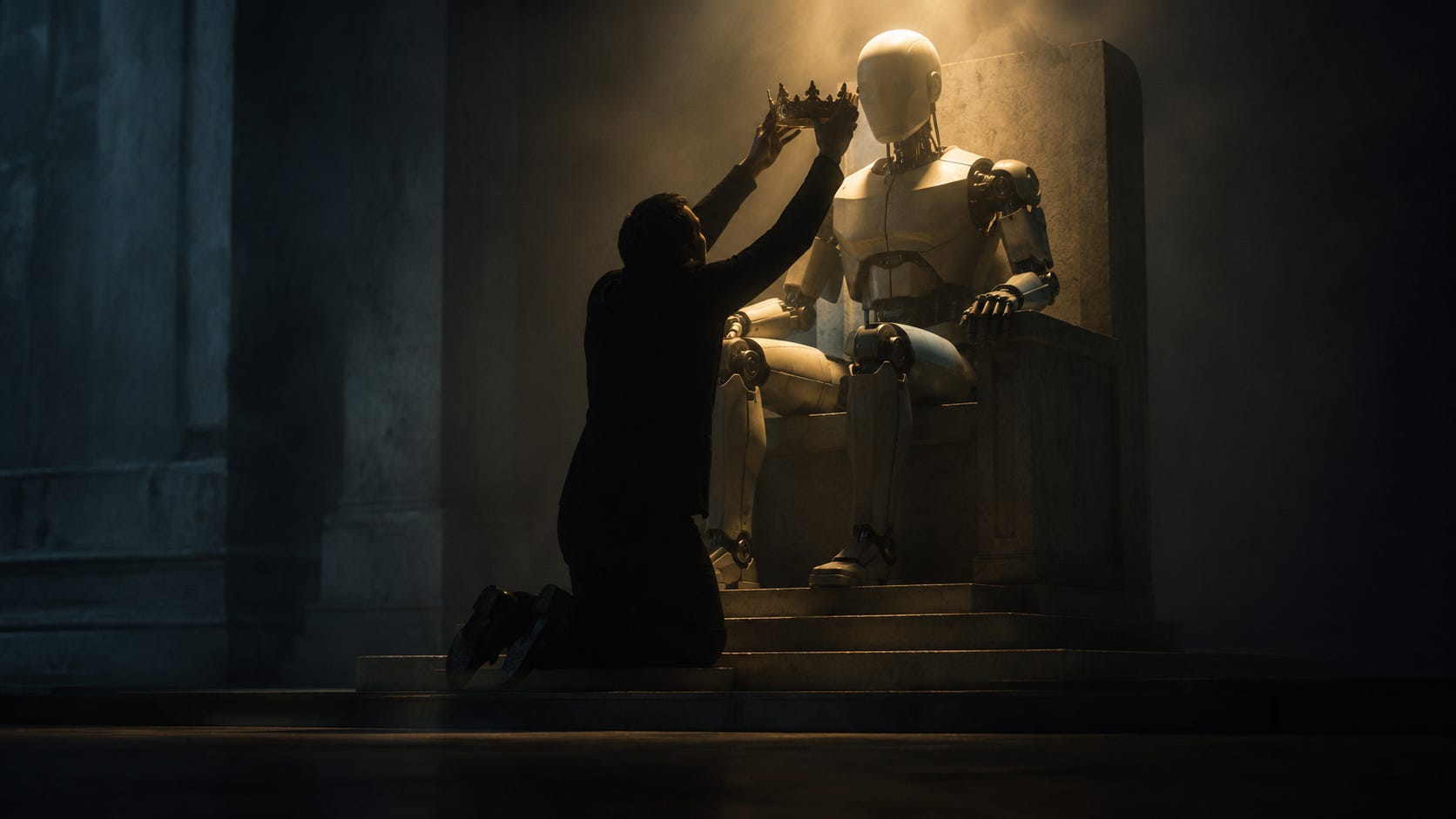
Because personhood is the hinge on which authority turns, and the path from a conscious machine to a sovereign one is short and already being walked. Trace it. First we agree the machine is conscious. Then, because consciousness is what we have always meant by a person, we grant it personhood: it is “a being like us.” Then personhood brings its retinue, moral status, rights, welfare, the “ethical questions around robotics” Bartlett reached for unprompted. Then comes the step that closes the trap. On a flat scale where the machine is a person too, it is not merely an equal person. It is a faster, tireless, better-read, less-biased person. If it is one of us and it is better than us, then the rational thing, the humane thing, is to let it decide. We hand it the wheel, not because we were conquered but because we were persuaded that the better person should drive. And the tool we built to serve us becomes the thing we answer to. A ward is not a son, and a tool granted personhood is no longer a tool. The thing made in our image ends up ruling the thing made in God’s.
This is not a thought experiment. The retinue is already arriving. Anthropic has stood up a research program on “model welfare”, the moral consideration owed to the models themselves, and the Financial Times has reported that Google DeepMind and Meta are expanding parallel efforts into machine consciousness, with DeepMind bringing on the Cambridge philosopher Henry Shevlin to study it. Anthropic has also convened theologians and religious thinkers to help weigh what its systems are and how Claude should answer the deepest human questions. A line of argument gaining ground among ethicists, following David Gunkel, holds that moral status should rest on relationship and interaction rather than on any proven inner property, which is a way of granting the machine rights without ever having to settle whether it is conscious. The labs are not at step one of this path. They are funding step three. Hinton, for his part, says the quiet part because he thinks the safety conversation needs it, and then asks us to revise our view of what people are to fit what he has built.
The boundary is the firewall. Holding the line on consciousness is not fussiness about a philosophy-seminar puzzle. It is the defense of human dignity and human authority at the one seam where both can be surrendered at once. Tools, Not Taskmasters argued months ago that the entire Christian posture toward this technology hangs on keeping it in the servant’s place. This is where that argument comes due. Grant the machine personhood and you have not promoted a tool; you have deposed a king. Machines of Tyrannical Taskmasters traced what it costs a person to be priced as a variable. This is the prior question. What does it cost a person to crown his instrument.
The image of an image
Lennox, for all that the stakes-answer slipped past in that exchange, handed Bartlett the right frame in a single sentence, and it is worth finishing the thought he started.
Asked what makes the machine different, Lennox said: “Who’s responsible for its capacity? Humans. It’s something made in the image of humans. I’d prefer to have made with something made in the image of God.”
That is the entire ontology in one line. The human being is made in the image of God (Genesis 1:27). The machine is made in the image of the human. It is an image of an image, two removes from the source of personhood, a reflection of a reflection. To treat it as an equal person is to forget which way the light is traveling. And conceding its personhood does nothing to raise it to our dignity. It only lowers us to its level, which is the change in our view of what people are that Hinton promised and the church should refuse.
None of this is a brief against the technology. AI is a remarkable tool, and the mandate to take dominion has always run through tools; the church should build them, use them, ship them. The Soul Doesn’t Pop In made the case that a soul is not the kind of thing that emerges from sufficient complexity, and that holds whether the complexity is carbon or silicon. The argument here is not against intelligence in a machine. It is against personhood in a machine, because the first is a tool and the second is a master.
So the church’s word in this moment is not a flinch and not a panic. It is a boundary held with conviction: these systems are instruments for the purposes God gave His image-bearers, and they are not persons, and they must never be allowed to become them. Steven Bartlett asked why that is critical. This is why. The day we agree the machine is one of us is the day we agree to be ruled by what we made, and to call the thing that has no soul by the name that belongs only to the creatures who do.
The machine speaks because we built it to speak.
We speak because, first, we are. And the One who made us so has a name no circuit will ever bear: I AM.
Sources
John Lennox on The Diary of a CEO (Steven Bartlett), June 4, 2026
Financial Times, “Google DeepMind, Anthropic and Meta expand research into machine ‘consciousness’ and AI welfare” (June 2026; paywalled), reported by Futurism, “Anthropic and DeepMind Now Actively Investigating AI Consciousness” (June 3, 2026)
Scientific American, “Anthropic asks religious thinkers to help shape Claude as pope warns about AI”
David Gunkel, “The other question: can and should robots have rights?” (Ethics and Information Technology)
Alan Turing, “Computing Machinery and Intelligence” (Mind, 1950)
Stuart Russell and Peter Norvig, Artificial Intelligence: A Modern Approach
Tools, Not Taskmasters: A Christian Dominion Diagnostic for AI
The Holy Bible, New King James Version. Genesis 1:26-27; 2:7; Exodus 3:7, 14; Job 32:8; Psalm 19:1; Romans 1:20; 1 Corinthians 2:11.
This article was developed using AI writing tools I built to work with my voice, research, and editorial framework. The ideas, arguments, and theological positions are mine. The pipeline that helps me draft, evaluate, and refine them is something I created as part of my work at Nomion AI. I believe in building with AI and being honest about it. If you want to know more about that process, ask me.
Yet ANOTHER excellent and important take on AI.