You'll Own Nothing
The WEF slogan is just Genesis 47. Pharaoh ran it first.

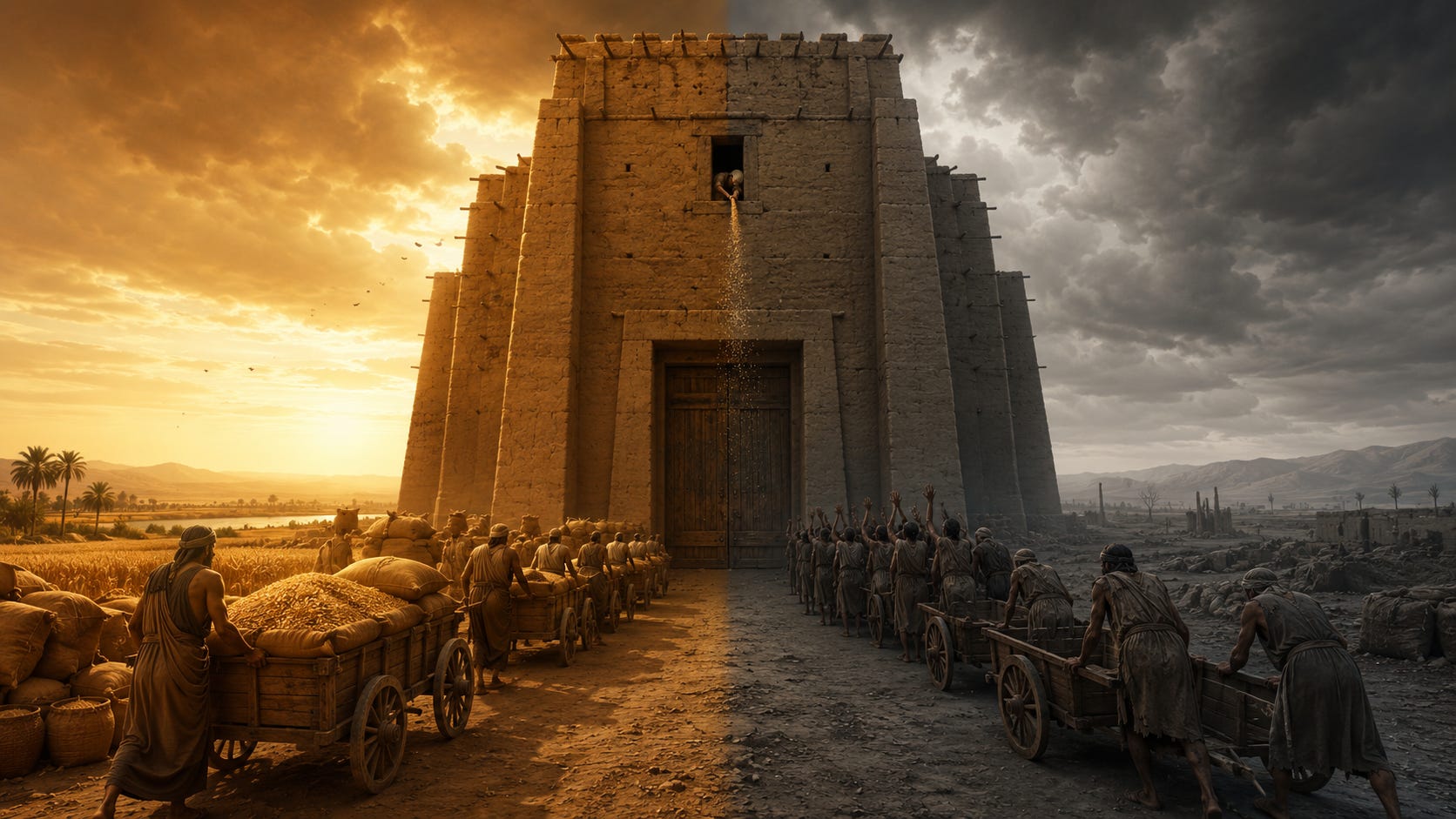
“You’ll own nothing, and you’ll be happy.”
The line is a decade old and everyone has heard some version of it. It grew out of a 2026-was-still-the-future essay the World Economic Forum ran in 2016, written by a Danish politician named Ida Auken and titled, with no irony she intended, “Welcome to 2030. I own nothing, have no privacy, and life has never been better.” Auken later protested that it was never her utopia, only a thought experiment. By then the phrase had escaped her. It became the slogan for every fear about a future where ordinary people hold no property, rent everything, and call the arrangement freedom.
We treat it as a forecast. A creepy one, a thing technocrats might do to us if we are not careful.
It is not a forecast. It is a memory.
The program “you’ll own nothing and you’ll be happy” describes was run to completion once already, about three and a half thousand years ago, and the most unsettling detail is not that it was imposed. It is that the people asked for it. “Buy us and our land for bread,” they said, “and we and our land will be servants of Pharaoh” (Genesis 47:19). By the end they were grateful. “You have saved our lives,” they told the man who now owned them (Genesis 47:25).
This week a socialist senator and a Republican president, four days apart, each reached for the same funding mechanism. That is what this piece is about: not whether the abundance is coming, but who will own the storehouse when it does.
The seven and the seven
Start with the part of the story everyone admires.
Pharaoh dreams of seven fat cows and seven thin ones, seven full heads of grain and seven blighted. Joseph reads it as an economic forecast: seven years of plenty, then seven years of famine. And he proposes a plan that is, by any reasonable measure, wise. “Let Pharaoh do this, and let him appoint officers over the land, to collect one-fifth of the produce of the land of Egypt in the seven plentiful years” (Genesis 41:34). Store the surplus under central authority. Hold it against the lean years coming. “Then that food shall be as a reserve for the land for the seven years of famine which shall be in the land of Egypt, that the land may not perish during the famine” (Genesis 41:36).
It works. “Joseph gathered very much grain, as the sand of the sea, until he stopped counting, for it was immeasurable” (Genesis 41:49). The granary fills. The famine comes exactly as predicted. And the reserve saves a civilization from starving.
Now hold that next to the present.
The years of plenty are not coming. They are here. The abundance that the All-In room keeps describing, the cheap intelligence, the productivity boom, the trillions of value the labs promise to unlock, is the seven fat years, and we are standing in them. The famine is the displacement on the other side, the one the previous two parts of this series traced: the work re-priced, the worker re-classified as a variable, the white-collar core thinned the way the weavers were thinned. The dream is a forecast of exactly the cycle we are living. Plenty, and then want.
So here is the only question that matters in a plenty-then-famine economy. Who is filling the granary now?
Because whoever accumulates during the plenty, the compute, the capital, the equity, the storehouse of the means of production, controls the food when the famine hits. And the tell is one verse most readers slide past. When the famine came, Joseph “opened all the storehouses and sold to the Egyptians” (Genesis 41:56).
Sold. Not gave. The grain the people grew, taxed away in the fat years and stored in Pharaoh’s cities, was sold back to them in the lean ones. The reserve was real mercy. It was also a position. And a position, in a famine, is leverage.
Give Joseph his due
Steelman the granary before we indict it, because the easy reading of this story is a cheap one.
Joseph is not a villain. The text does not present him as one. His plan was prudence of the highest order. A society that eats its surplus in the fat years and stores nothing has condemned itself, and there is a long, honest tradition of conservative thought that would call Joseph’s one-fifth reserve exactly the kind of foresight a wise steward owes the future. Centralization here is not greed. It is competence. The man saw what was coming and built the thing that kept a generation alive.
This matters because the reflex on my side of the aisle is to treat every concentration of resources as theft on its face, and that reflex is lazy. Sometimes the storehouse is the only thing standing between a population and mass death. The abundance case for AI has a version of this that I more than half believe: that immense productivity, captured and deployed well, could underwrite a genuinely better century. Storing against the lean years is not the error.
The error is downstream, and it is structural, and Joseph could not see it because no one inside a benevolent system ever can. The mercy and the mechanism are the same mechanism. The granary that feeds you in the famine is the granary that owns you by the end of it. Watch how.
The price turns out to be everything
The famine deepens, and the people come to buy. First they come with money.
“Joseph gathered up all the money that was found in the land of Egypt and in the land of Canaan, for the grain which they bought; and Joseph brought the money into Pharaoh’s house” (Genesis 47:14). Every coin in two nations flows into the storehouse. Then the money runs out, and the famine does not. “Give us bread,” they cry, “for why should we die in your presence? For the money has failed” (Genesis 47:15).
So they pay with the next thing they own. “Give your livestock, and I will give you bread for your livestock, if the money is gone” (Genesis 47:16). The horses, the flocks, the cattle, the donkeys, all of it traded for one more year of food. Then that year ends too, and there is nothing left but the two things a person has when everything else is gone: his land and himself.
So he sells those. “Buy us and our land for bread, and we and our land will be servants of Pharaoh” (Genesis 47:19). And the deal closes. “Then Joseph bought all the land of Egypt for Pharaoh, for every man of the Egyptians sold his field, because the famine was severe upon them. So the land became Pharaoh’s” (Genesis 47:20). The people themselves are relocated, “from one end of the borders of Egypt to the other end” (Genesis 47:21), now tenants on ground they used to own, working seed that is loaned to them: “Indeed I have bought you and your land this day for Pharaoh. Look, here is seed for you, and you shall sow the land” (Genesis 47:23).
Money, then livestock, then land, then themselves. The price of the dole was never zero. It just escalated, one famine-year at a time, until it had taken everything a person could be made to give.
And here is the end state, set down in Scripture with a precision no policy paper achieves. Pharaoh owns the money, the cattle, the land, and the people. The people own nothing. They receive a grain ration in exchange for four-fifths of what they grow, and they call the arrangement salvation: “You have saved our lives; let us find favor in the sight of my lord, and we will be Pharaoh’s servants” (Genesis 47:25).
That is “you’ll own nothing and you’ll be happy,” written in the second millennium before Christ. A population with no money, no capital, no land, and no equity in the system that fed them, holding a ration and grateful for it. The slogan is not a prediction of where we might go. It is a description of where we have already been, and the Bible filed the report.
Two roads, one granary
The abundance everyone promises has a problem nobody funds, as Bill Maher observed on his show last week: if the machines do the work and the people do not, the universal income has to come from somewhere, and the machine is busy eliminating the tax base that would pay for it. The cybernetic meadow runs on revenue it is built to destroy.
There are only two ways to fund a dole that large, and both of them fill Pharaoh’s storehouse.
The first road is to debase. Print it, expand the balance sheet, monetize the gap. The ration arrives, and it buys a little less each year, and the people holding currency lose while the people holding real assets, the data centers, the compute, the equity, the land, win quietly and enormously. Inflation is the most regressive tax there is, and it is the one that requires no vote.
The second road is to expropriate. Nationalize the industry, seize the equity, and redistribute the proceeds. This is the road my own tradition is supposed to reject on sight, and I do reject it. I am not a socialist and I am not a communist, and anyone who has read me knows the ground I stand on. But the road has traffic on it for reasons worth taking seriously. The displacement is real, the fear is rational, and a generation watching its earning power evaporate is not going to stay patient forever. The political wind behind expropriation is not going to weaken. It is going to build.
Notice what both roads share. Debase, and ownership concentrates in whoever holds the real assets. Expropriate, and ownership concentrates in whoever votes the seized equity. Either way the population ends up holding grain, not property. Either way you arrive at Genesis 47. The argument between the two roads is an argument about the address of the granary, not about whether there will be one.
The state’s answer arrived, from both doors at once
The granary is not hypothetical. This week both ends of American politics walked toward it in public, four days apart.
On June 2, Senator Bernie Sanders announced that he will introduce a bill “to give the public a 50% ownership stake in the largest AI companies in America,” so that “the trillions created by AI are used to improve the lives of all of us.” The reported vehicle is an American AI Sovereign Wealth Fund: a one-time tax levied not on the profits of the frontier labs but on their stock, with the equity held in a federal fund and the returns paid out as direct payments, plus health care, education, and housing framed as rights. This is the road the left was always going to take, the expropriate road, and Sanders is simply the one holding the pen.
Then, on June 5, the other pole moved. President Trump told reporters his team is in talks with the heads of the largest AI companies about the government acquiring “pieces” of their firms, and said he wants to invite “all of them” to the White House within the week. One version under discussion has the companies cede shares to the government voluntarily, with the earnings routed to “broad public benefit,” including the possibility of dividend checks to American households. This is not a fringe musing. The administration has already taken stakes in Intel, IBM, and a string of quantum and critical-mineral companies in this term. And the detail that should stop you: Sam Altman, the CEO of OpenAI, is the one who brought the idea of voluntarily ceding AI shares to the government to Trump personally. The lab is inviting the state in.
Sit with what just happened. The democratic socialist wants the government to seize half the equity. The Republican president wants the government to be handed pieces of it. They disagree about the mechanism, tax versus voluntary cession, and they agree, in the same week, on the structure: the government holds a stake in the frontier labs, and the people get a dividend. Left and right, populist and president, arriving at one architecture from opposite directions. When the two poles of a polarized country converge this fast on the same instrument, the instrument is not a check on concentrated power. It is concentration, and the partisan label on it is decoration.
Give the diagnosis its due, because part of it is correct, especially on Sanders’s side. He argues the labs built their fortunes on a commons they never paid for, the “collective experience, knowledge and learnings of humanity,” the books and songs and code and journalism scraped without consent. He quotes Altman conceding as much. “The time has come,” he says, “to reclaim what was stolen from us.” On the question of whether something was taken, he is not wrong, and Christians of all people should be able to say so. Withheld wages cry out. Theft incurs a debt.
But look at where the reclaimed wealth goes, on either road, because that is the whole argument. It does not go to the robbed. It goes to a fund. And the citizen, at the end of it, owns no share of the machine. He owns a claim on a dividend that some authority decides each year whether and how to pay. “Public ownership” and “the American public becomes a partner” are the phrases doing the laundering, and both poles reach for them. Operationally the public owns nothing and votes nothing. A government fund owns it, and a political appointee votes it, and “the public” means the state holding the asset on the public’s behalf, which is precisely the arrangement Genesis 47 describes. The fund is the storehouse. The dividend is the grain ration. “Improve the lives of all of us,” “the American people can benefit from the success of AI,” is “you have saved our lives.” The citizen holds a claim on bread, and Pharaoh holds the land.
Clean Outside the Cup traced this exact maneuver a few days ago: a thing that sounds like diffusion and operates as concentration. The real axis was never oligarchs against the people, or left against right. It is concentrated against distributed, and a government stake in the largest labs keeps it concentrated whoever signs the order, merely relocating the steward to the Beltway. Notice, too, what the move does for the labs. A government stake in the largest AI companies is a moat for the largest AI companies. It co-opts the state as co-owner and protector, entrenches the incumbents against anyone smaller, and quietly retires the liability for the scraped commons. That is why the CEO is the one proposing it. The fox has offered to help build the henhouse, on the condition that he gets to live inside.
The receipt is short, because the argument does not need it. A month ago, The Water Is Still Going Out forecast that the coming policy swing would reach for “a partial nationalization of AI infrastructure,” that it would be “techno-feudalism with a different address,” and that the campaign would offer substitution where the gospel demands restitution. I expected it to come from the left. It is arriving from the left and the right in the same week, which is not a softer version of the forecast but a harder one. The granary does not care which party builds it.
Restitution runs to the robbed. Zacchaeus repaid the people he defrauded, fourfold, to their faces (Luke 19:8). The law in Exodus 22 returns what was taken to the victim, not to the king. Routing the proceeds of a scraped commons into a federal fund that rations them back is not restitution, on either road. It is substitution, and the true public it claims to serve is made of persons, not the Treasury.
The king who did not know Joseph
Here is the sentence that turns this from dark to devastating, and it sits one chapter past the granary.
Joseph’s centralization saved Egypt. The man was benevolent, the plan was mercy, the storehouse kept a generation alive. And then time did the only thing time reliably does. “Now there arose a new king over Egypt, who did not know Joseph” (Exodus 1:8).
The same machinery, one administrator later. The granary that fed the people became the apparatus that enslaved them, not because the apparatus changed but because the hand on it did. Total dependence on a benevolent power is total dependence on the next power to inherit the levers, and you do not get to choose that one. The kindly overlord of the last piece and the taskmaster of the one before it are not two systems. They are one system at two moments, the same infrastructure, one regime change apart. Benevolence is not a safeguard. It is a phase.
This is the argument against handing your whole future to the storehouse, and it requires no better policy of your own to land. A population owning nothing and fed by a central provider is a population betting its children on the character of an administrator it has not met. Israel learned this. They had asked for a king years before they should have, and Samuel told them in advance exactly how the central provider works: “He will take your sons... he will take a tenth of your sheep. And you will be his servants” (1 Samuel 8:11, 17). Take, take, take, and then the line that should stop anyone reaching for the grain-king as a savior: “And you will cry out in that day because of your king whom you have chosen for yourselves, and the LORD will not hear you in that day” (1 Samuel 8:18).
You can choose the storehouse. You cannot un-choose it when the new king arrives.
Buy and sell
There is a place this logic ends, and the Bible describes it without flinching. The terminal form of a buy-and-sell economy, where access to the means of life is concentrated in a single authority, appears in Revelation 13: a system in which “no one may buy or sell except one who has the mark or the name of the beast” (Revelation 13:17). Total permission control over the ability to transact, held in one hand.
I am not reading the headlines as prophecy and I am not putting a clock on the end of the age. The shape is what matters. The direction of a granary economy, the logic that takes the money, then the livestock, then the land, then the man, does not relax on its own. It runs toward a single point of control over who may eat. Scripture’s last word on that trajectory is not abundance. It is a mark, and a question at the threshold of every transaction about whose authority you carry.
Heirs, not servants
Against “you’ll own nothing,” the kingdom offers the exact inverse, and the contrast is the whole point.
Pharaoh’s economy ends with a servant who owns nothing, fed a ration to keep him working land that is no longer his. The gospel’s economy ends with an heir who inherits everything. “And if children, then heirs, heirs of God and joint heirs with Christ” (Romans 8:17). Not a tenant on the master’s field. A co-owner of the master’s estate. The inheritance is described in terms no sovereign wealth fund can promise, “incorruptible and undefiled and that does not fade away, reserved in heaven for you” (1 Peter 1:4), a holding no inflation debases and no new king expropriates. And the recipients are specified with a precision that reverses the whole logic of the granary: “Blessed are the meek, for they shall inherit the earth” (Matthew 5:5). Not the ones who accumulated the storehouse. The ones who owned nothing get the deed.
This completes a turn the last two weeks have been making. Machines of Loving Grace took the deity question, who decides what you are worth, and found the answer in a worth that is crowned, not computed. Machines of Tyrannical Taskmasters took the labor question, who prices your work, and found a God who knows the worker’s sorrows rather than pricing his output. This is the third question, the ownership question, who holds everything when the work is gone, and the answer rhymes with the other two. Worth crowned, not computed. Labor known, not priced. Inheritance given, not seized.
Pharaoh buys you with bread and calls it salvation. He takes the money, the cattle, the land, and the man, hands back a ration, and lets you thank him for it. Christ does the opposite motion at every step. He owns everything, and instead of buying you, He sells everything to buy you back, and instead of making you a servant, He makes you a son, and instead of issuing you a ration, He hands you the inheritance. The cross is the anti-Genesis-47. One sovereign acquires a people by taking until they have nothing. The other acquires a people by giving until He has nothing, and what He gives them is everything He owns.
Salaries to Servers traced the capital migrating out of human hands and into infrastructure and asked who would carry the cost. This is the cost, shown at full size. The end of that migration, run to completion, is a people who own nothing and are told to be happy. I do not have the policy that stops it, and I distrust the people selling one, on both roads. What I have is the older and stranger claim that there is a different sovereign with a different deal, and that His does not end in a storehouse.
You’ll own nothing, the slogan says, and you’ll be happy.
The God who made you owns everything, and He died to put your name on the deed.
Sources
The Holy Bible, New King James Version. Genesis 41:34-36, 49, 56; 47:14-25; Exodus 1:8; 1 Samuel 8:11-18; Luke 19:8; Exodus 22; Romans 8:17; 1 Peter 1:4; Matthew 5:5; Revelation 13:16-17.
This article was developed using AI writing tools I built to work with my voice, research, and editorial framework. The ideas, arguments, and theological positions are mine. The pipeline that helps me draft, evaluate, and refine them is something I created as part of my work at Nomion AI. I believe in building with AI and being honest about it. If you want to know more about that process, ask me.
So profound and so true a warning! Thank you again Miles, for sounding the alarm and trying to make others aware that the road ahead is out. Change direction and be saved!
I choose Jesus.
Lord help the deaf hear, the blind to see and the bound to be free in Jesus name I pray amen.
But surely we can trust the government, can't we? (said no one with any common sense... lol)